When the Word of Jesus Lies Buried
Saturday and the Silence That Tests Every Claim
Primary Texts: Matthew 27:57–66; Mark 15:42–47; Luke 23:50–56; John 19:38–42; Matthew 12:40; Matthew 16:21; Matthew 17:22–23; Matthew 20:18–19
Main Sayings: “The Son of Man will be three days and three nights in the heart of the earth.” “He will be raised on the third day.” “After three days I will rise.” “Destroy this temple, and in three days I will raise it up.”
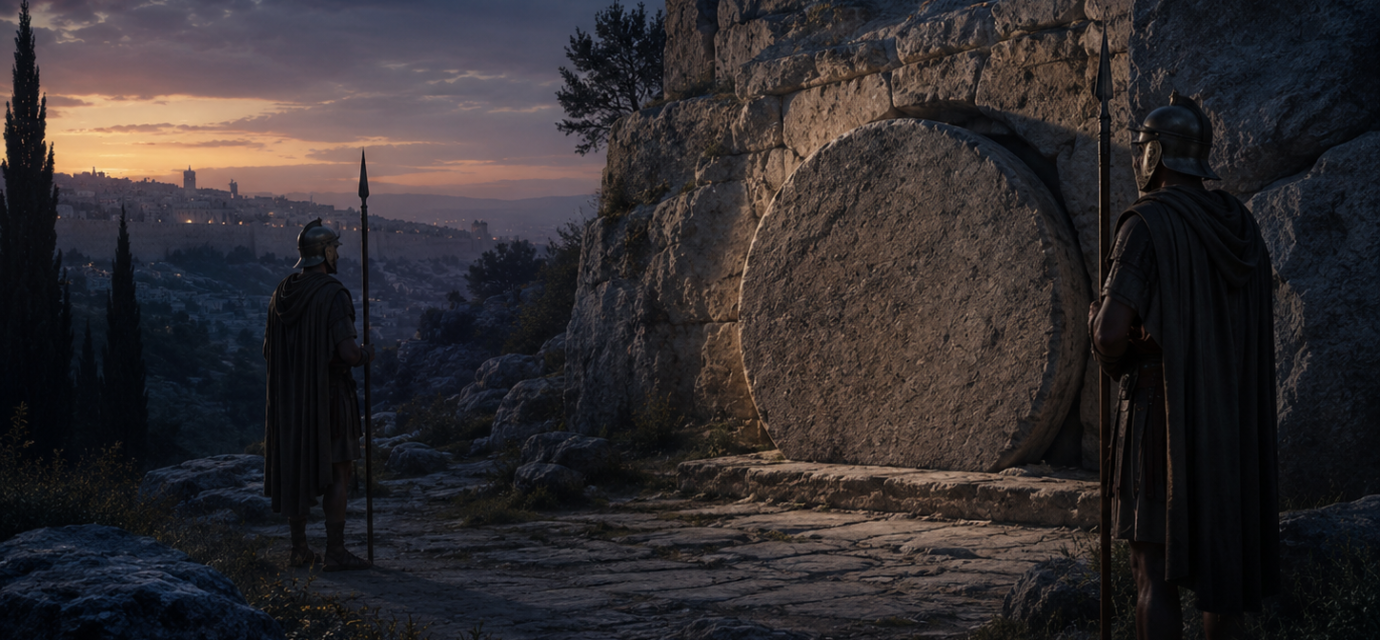
The stone was rolled.
The tomb was sealed.
The body lay cold and still.
And everything went silent.
Saturday is the day hope looks dead.
The day obedience looks foolish.
The day Jesus’ enemies seem to have the last word.
But the silence of God is not the absence of God.
The Promise Was Buried
Jesus had spoken.
Not once.
Many times.
He said He would be delivered into the hands of men.
He said He would be killed.
He said He would rise on the third day.
The words had been spoken.
The promise had been made.
But now the One who spoke those words was buried.
The claim lay in the tomb with Him.
That is what makes Saturday so haunting.
It is not only silence after violence.
It is silence after promise.
The Stone Still Stood
The women had seen where His body was laid.
The disciples were scattered.
The authorities remembered His words just enough to fear a rumor.
So they sealed the tomb.
They posted guards.
They tried to make death secure.
But no seal can imprison the Word of God.
No soldier can guard against the power of God.
No tomb can hold the Lord of life.
Still, Saturday makes us wait before we say that.
It will not let us rush too quickly to Easter.
The Silence Tests Us
Saturday asks a hard question.
Can you trust the words of Jesus when everything visible seems to contradict them?
The disciples struggled.
They had seen His power.
They had heard His teaching.
They had confessed Him as Christ.
But now grief pressed down.
Fear closed in.
The cross shattered their categories.
They did not yet understand.
Suffering was not the failure of Jesus’ mission.
It was the road His mission had always taken.
Every Heart Knows Saturday
The skeptic looks at Saturday and says, “Dead men stay dead.”
The seeker wonders, “Could there be more than this?”
The believer whispers, “Lord, I believe; help my unbelief.”
Every human heart eventually knows Saturday.
A prayer seems unanswered.
A hope seems dead.
A promise feels delayed.
A loss becomes impossible to explain.
Silence stretches longer than you thought you could bear.
And then the question comes:
Will you trust Jesus only when you can see what He is doing?
Or will you trust Him because of who He is?
The Word Does Not Decay
Saturday does not ask you to pretend grief is small.
It does not ask you to call darkness light.
It does not ask you to deny the weight of the stone.
It asks whether Jesus’ words are still true when the world looks sealed against them.
His words do not become weak in the dark.
His promises do not decay in the tomb.
His authority does not end where human visibility ends.
The Word of Jesus may lie buried.
But it cannot be broken.
The Verdict
God is not absent because He is silent.
He is not defeated because He is unseen.
He is not late because we are waiting.
The disciples did not yet understand.
The women still mourned.
The guards still watched.
The stone still stood.
But the promise was still alive.
So do not mistake silence for abandonment.
Do not mistake waiting for failure.
Do not mistake the sealed tomb for the end of the story.
Jesus has not forgotten His word.
The stone has not moved yet.
But it will.
Key Verse
“They went and made the tomb secure by sealing the stone and setting a guard.”
— Matthew 27:66
One Sentence to Remember
The silence of God is not the absence of God.
Discussion Question
Where are you being asked to trust Jesus while the promise still seems buried?
A Prayer for the Day
Lord Jesus, I confess that I struggle in the silence. I want answers quickly. I want the stone moved now. Forgive me for mistaking waiting for abandonment. Teach me to trust Your words when I cannot yet see their fulfillment. Hold me steady in the dark. You have never broken a promise, and You will not begin now. Amen.

Roger Wamba Sador
Roger is a student of Christocentric Apologetics, a passionate Servant of God whose work for JesusAccordingToJesus.com focuses on Passion Week, prophetic fulfillment, and the climactic self-revelation of Jesus in His death and resurrection. His writing examines the final days of Jesus’ earthly ministry with careful attention to the Gospel narratives: the triumphal entry, the cleansing of the temple, the confrontations in Jerusalem, the Last Supper, Gethsemane, the trials, the cross, the burial, the empty tomb, and the resurrection appearances. He is especially interested in how these events reveal not only what happened to Jesus, but who Jesus understood Himself to be and what He came to accomplish. Roger brings an analytical and historically attentive approach to the biblical text, tracing the connection between Jesus’ words, His deliberate movement toward Jerusalem, and the prophetic pattern fulfilled in His suffering, death, and vindication. His work presses readers to see that Passion Week was not a tragic accident or a religious symbol added later, but the purposeful fulfillment of Jesus’ mission. Rather than treating prophecy as vague prediction or detached proof-texting, Roger explores how the Scriptures converge in the person and work of Christ. His writing helps readers see the cross and resurrection as the decisive center of the Gospel: the place where Jesus’ identity, mission, authority, obedience, sacrifice, and victory come fully into view. Roger writes for seekers, skeptics, believers, and serious students of Scripture who want to understand why the final week of Jesus’ life stands at the heart of the Christian proclamation: He died, He was buried, He rose again, and He is alive.