
Thirty Pieces of Silver or Everything You Have.
This is Jesus According to Jesus. This reflection belongs to our Passion Week collection. Its focus is this: The final week did not happen to Jesus. He walked into it. From Palm Sunday to Resurrection Sunday, Jesus enters Jerusalem as King, confronts empty religion, exposes hypocrisy, predicts judgment, gives His body and…. Listen carefully and think about what Jesus says. Let’s begin.
Thirty Pieces of Silver or Everything You Have.
Wednesday and the Day Everyone Picked a Side.
Two people.
Two responses.
One Jesus.
And the whole world still stands somewhere between them.
One woman poured out costly perfume in worship. One man sold Jesus for thirty pieces of silver. One saw Him as worthy of everything. One decided He was worth a transaction.
Wednesday asks the question no one can finally avoid:
What is Jesus worth to you?
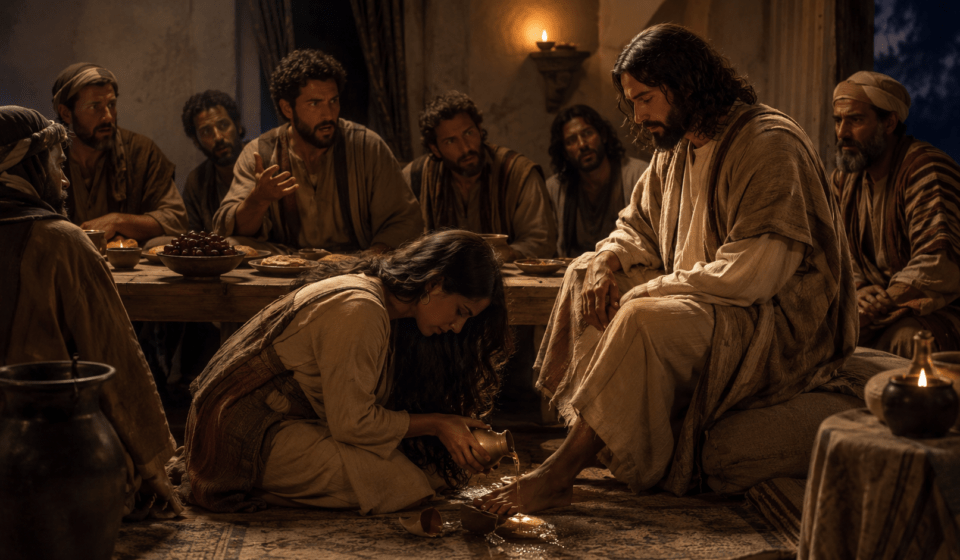
Jesus was in Bethany, reclining at a table, when Mary came carrying a sealed stone jar of perfume worth a fortune. It was costly—worth nearly a year’s wages. This was not spare change. This was not a convenient gift. This was treasure.
She broke the stone jar and poured the perfume over Jesus.
The fragrance filled the house.
Some were indignant. “Why this waste?” they asked. The perfume could have been sold. The money could have been given to the poor. Their objection sounded noble. It sounded practical. It sounded responsible.
But Jesus defended her.
“She has done a beautiful thing to Me.”
Then He explained what even His disciples were struggling to understand:
“She has done it to prepare Me for burial.”
Mary saw something others missed.
Jesus had been telling His disciples that He was going to suffer, be rejected, killed, and raised. Still, they did not grasp the weight of it. But Mary’s act said what words could barely hold: the King was going to die. The Lamb was moving toward sacrifice. The One she loved was worthy of honor before the world covered Him in shame.
Her worship was not waste.
It was recognition.
She did not merely give Jesus something expensive. She gave Him something unrecoverable. Once the flask was broken and the perfume poured out, there was no taking it back.
That is what love does when it sees worth clearly.
It stops calculating.
But nearby, another response was forming.
Judas Iscariot went to the chief priests and asked, “What will you give me if I deliver Him over to you?”
They counted out thirty pieces of silver.
Thirty pieces.
The price of betrayal.
The price placed on the life of the One Judas had walked with, eaten with, listened to, and followed.
Mary broke the flask.
Judas made a deal.
Mary poured out treasure.
Judas collected silver.
Mary prepared Jesus for burial.
Judas prepared the way for His arrest.
This is the terrible clarity of Wednesday: everyone assigns a value to Jesus.
Not just Mary. Not just Judas. Everyone.
The skeptic does. The seeker does. The believer does. The indifferent person does. The churchgoer does. The critic does. The disciple does.
We may not say the number out loud, but our lives declare it.
What is Jesus worth in your decisions?
What is He worth in your money?
What is He worth in your ambitions?
What is He worth in your relationships?
What is He worth in your private life?
What is He worth when obedience costs you comfort, reputation, control, or sin you do not want to surrender?
It is easy to condemn Judas from a distance. But betrayal rarely begins with open hatred. Often it begins with disappointment. Jesus does not become useful in the way we expected. He does not serve our agenda. He does not fulfill our ambitions. So we begin to keep something back.
Mary shows us the opposite.
She does not use Jesus. She worships Him.
She does not ask what she can gain. She gives what she cannot reclaim.
She does not treat devotion as wasteful because she sees Jesus as worthy.
And Jesus receives it.
That matters. Jesus does not rebuke extravagant love toward Him. He does not call it excessive. He does not say, “That was too much.” He says it was beautiful.
Wednesday divides the room.
Some call worship waste.
Some call betrayal practical.
Some keep their options open.
Some break the jar.
But no one stays neutral forever.
You cannot stand with Mary while clinging to Judas’s silver. You cannot pour yourself out before Jesus while secretly negotiating the terms of your loyalty.
So the question stands:
What is Jesus worth to you?
Not in theory.
Not in religious language.
Not when the cost is low.
What is He worth when following Him means the flask must break?
Mary’s fragrance filled the house.
Judas’s silver bought nothing but blood.
And Jesus kept moving toward the cross, not surprised, not trapped, not defeated. He knew the worship. He knew the betrayal. He knew the burial ahead.
Still, He gave Himself.
The One Mary worshiped and Judas sold is the One who would soon pour out His own life for sinners.
So bring Him your calculations.
Bring Him your bargains.
Bring Him your guarded heart.
Then look again.
He is worth more than the silver.
He is worth more than the perfume.
He is worth everything.
Key Verse.
“She has done it to prepare Me for burial.”
— Matthew 26:12
One Sentence to Remember.
Passion Week forces the question: What is Jesus worth to you?
Discussion Question.
What would it cost you to break your “alabaster jar” before Jesus?
A Prayer for the Day.
Lord Jesus, I confess that I have often calculated Your worth. I have weighed obedience against comfort and held parts of my life back from You. Forgive me. Open my eyes to see You as Mary did: worthy, beautiful, and beyond price. Break my bargaining heart. Teach me to pour out my life before You in worship, trust, and surrender. Amen.

Roger Wamba Sador
Roger is a student of Christocentric Apologetics, a passionate Servant of God whose work for JesusAccordingToJesus.com focuses on Passion Week, prophetic fulfillment, and the climactic self-revelation of Jesus in His death and resurrection. His writing examines the final days of Jesus’ earthly ministry with careful attention to the Gospel narratives: the triumphal entry, the cleansing of the temple, the confrontations in Jerusalem, the Last Supper, Gethsemane, the trials, the cross, the burial, the empty tomb, and the resurrection appearances. He is especially interested in how these events reveal not only what happened to Jesus, but who Jesus understood Himself to be and what He came to accomplish. Roger brings an analytical and historically attentive approach to the biblical text, tracing the connection between Jesus’ words, His deliberate movement toward Jerusalem, and the prophetic pattern fulfilled in His suffering, death, and vindication. His work presses readers to see that Passion Week was not a tragic accident or a religious symbol added later, but the purposeful fulfillment of Jesus’ mission. Rather than treating prophecy as vague prediction or detached proof-texting, Roger explores how the Scriptures converge in the person and work of Christ. His writing helps readers see the cross and resurrection as the decisive center of the Gospel: the place where Jesus’ identity, mission, authority, obedience, sacrifice, and victory come fully into view. Roger writes for seekers, skeptics, believers, and serious students of Scripture who want to understand why the final week of Jesus’ life stands at the heart of the Christian proclamation: He died, He was buried, He rose again, and He is alive.