
No One Takes His Life — He Gives It.
This is Jesus According to Jesus. This reflection belongs to our Passion Week collection. Its focus is this: The final week did not happen to Jesus. He walked into it. From Palm Sunday to Resurrection Sunday, Jesus enters Jerusalem as King, confronts empty religion, exposes hypocrisy, predicts judgment, gives His body and…. Listen carefully and think about what Jesus says. Let’s begin.
No One Takes His Life — He Gives It.
Thursday and the Night Everything Changed.
Primary Texts: Matthew 26:17–56; Mark 14:12–52; Luke 22:7–53; John 13:1–18:11; Exodus 12:1–14; Jeremiah 31:31–34
Main Sayings: “This is My body.” “This cup is the new covenant in My blood.” “If I do not wash you, you have no share with Me.” “I have given you an example.” “Not My will, but Yours be done.” “Put your sword back into its place.”
The lamb had to be without blemish.
The lamb had to be examined.
The lamb had to be slain.
And Jesus knew exactly what He was doing.
Thursday is not the night Jesus lost control.
It is the night He gave Himself.
Bread was broken.
Feet were washed.
Blood was promised.
Sweat fell like drops of blood.
A friend betrayed Him with a kiss.
And the Son of God said:
“Not My will, but Yours be done.”
The Servant Took the Lowest Place.
Imagine the room.
Twelve men reclining at a table.
Passover was near.
The sacred meal of deliverance.
Blood.
Judgment.
Rescue.
But there was dust on their feet.
And no one moved.
Foot washing was servant work.
The lowest work.
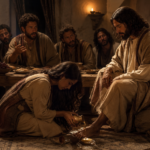
So Jesus got up.
He laid aside His outer garment.
He wrapped a towel around His waist.
He took a basin.
He knelt.
And the Lord of glory washed dirty feet.
Not because He forgot who He was.
Because He knew exactly who He was.
You Must Be Washed by Him.
Peter protested.
“You shall never wash my feet.”
It sounded humble.
It was not.
It was resistance.
Jesus answered:
“If I do not wash you, you have no share with Me.”
That sentence cuts deep.
You cannot belong to Christ while refusing to be cleansed by Christ.
You cannot keep your pride and receive His washing.
You cannot admire His humility while rejecting your need.
The King who commands is also the Servant who stoops.
He does not only tell sinners to be clean.
He cleanses them.
Then He says:
“I have given you an example.”
Receive My cleansing.
Then learn My way.
No pride.
No superiority.
No greatness that refuses to serve.
The Bread Was Not Empty Ritual.
Then Jesus took bread.
He blessed it.
He broke it.
He gave it to them.
“Take, eat; this is My body.”
Then He took the cup.
“This cup is the new covenant in My blood, which is poured out for you.”
Not bare ritual.
Not vague sentiment.
This was interpretation.
Jesus was telling them what His death meant before it happened.
His body would be given.
His blood would be poured out.
The new covenant would be established.
Not through the blood of another lamb.
Through the Lamb of God Himself.
The Passover had been pointing forward.
Jesus was saying:
It has been pointing to Me.
The Son Faced the Cup.
Then came Gethsemane.
Jesus went to pray.
He took Peter, James, and John.
He became deeply distressed and troubled.
He said:
“My soul is very sorrowful, even to death.”
Do not rush past this.
Jesus did not walk toward the cross numb.
He did not treat suffering casually.
He saw the cup.
He felt the weight.
He trembled before the horror ahead.
Then He prayed:
“Abba, Father, all things are possible for You. Remove this cup from Me. Yet not what I will, but what You will.”
This is obedience with open eyes.
This is surrender without pretending.
This is the Son, knowing the cost, yielding Himself to the Father.
He Could Have Ended It.
Then Judas came.
A kiss.
A betrayal.
Soldiers.
Swords.
Clubs.
Peter drew his sword.
He struck the servant of the high priest.
Jesus stopped him.
“Put your sword back into its place.”
Then Jesus made the truth plain.
He could appeal to His Father.
He could summon more than twelve legions of angels.
He could have ended the arrest.
He could have shattered the garden.
He could have walked away.
But He did not.
Because the cross was not merely something done to Jesus.
It was something Jesus came to do.
No One Takes His Life.
No one trapped Him.
No one overpowered Him.
No one forced Him to save sinners.
Before soldiers bound His hands, Jesus had already placed His life in the Father’s hands.
Before Judas kissed His cheek, Jesus had already chosen the cross.
Before the world condemned Him, He had already resolved to save it.
Do not pity Him as helpless.
Bow before Him as willing.
The Lamb gives Himself.
The Verdict.
Thursday does not ask for sentiment.
It demands surrender.
Will you let Jesus wash you?
Will you receive His broken body and poured-out blood?
Will you lay down the sword of self-protection?
Will you stop fighting for control?
Will you pray, “Not my will, but Yours be done”?
The Servant-King is not asking to be admired from a distance.
He is calling you into His cleansing.
His table.
His humility.
His surrender.
His life.
No one takes His life.
He gives it.
And the only right response is trust, obedience, and worship.
Key Verse.
“Not My will, but Yours be done.”
— Luke 22:42
One Sentence to Remember.
Before soldiers bound His hands, Jesus had already placed His life in the Father’s hands.
Discussion Question.
Where are you resisting the prayer, “Not my will, but Yours be done”?
A Prayer for the Day.
Lord Jesus, You gave Yourself freely. No one took Your life from You; You laid it down. Wash me. Cleanse me. Teach me to receive Your sacrifice with faith and follow Your humility with obedience. Where I cling to control, teach me surrender. Where I resist Your will, make me willing. Not my will, but Yours be done. Amen.

Roger Wamba Sador
Roger is a student of Christocentric Apologetics, a passionate Servant of God whose work for JesusAccordingToJesus.com focuses on Passion Week, prophetic fulfillment, and the climactic self-revelation of Jesus in His death and resurrection. His writing examines the final days of Jesus’ earthly ministry with careful attention to the Gospel narratives: the triumphal entry, the cleansing of the temple, the confrontations in Jerusalem, the Last Supper, Gethsemane, the trials, the cross, the burial, the empty tomb, and the resurrection appearances. He is especially interested in how these events reveal not only what happened to Jesus, but who Jesus understood Himself to be and what He came to accomplish. Roger brings an analytical and historically attentive approach to the biblical text, tracing the connection between Jesus’ words, His deliberate movement toward Jerusalem, and the prophetic pattern fulfilled in His suffering, death, and vindication. His work presses readers to see that Passion Week was not a tragic accident or a religious symbol added later, but the purposeful fulfillment of Jesus’ mission. Rather than treating prophecy as vague prediction or detached proof-texting, Roger explores how the Scriptures converge in the person and work of Christ. His writing helps readers see the cross and resurrection as the decisive center of the Gospel: the place where Jesus’ identity, mission, authority, obedience, sacrifice, and victory come fully into view. Roger writes for seekers, skeptics, believers, and serious students of Scripture who want to understand why the final week of Jesus’ life stands at the heart of the Christian proclamation: He died, He was buried, He rose again, and He is alive.