
The Son on Trial Becomes the Judge.
This is Jesus According to Jesus. This reflection belongs to our Passion Week collection. Its focus is this: The final week did not happen to Jesus. He walked into it. From Palm Sunday to Resurrection Sunday, Jesus enters Jerusalem as King, confronts empty religion, exposes hypocrisy, predicts judgment, gives His body and…. Listen carefully and think about what Jesus says. Let’s begin.
The Son on Trial Becomes the Judge.
Tuesday and the Day the Interrogation Backfired.
Primary Texts: Matthew 21:23–23:39; Matthew 24:1–25:46; Mark 11:27–13:37; Luke 20:1–21:38; Psalm 118:22–23; Daniel 7:13–14
Main Sayings: “By what authority are you doing these things?” “The stone that the builders rejected has become the cornerstone.” “Render to Caesar the things that are Caesar’s, and to God the things that are God’s.” “The Son of Man will come in His glory.” “Stay awake.”
The questions were ready.
The traps were set.
The verdict was already written.
Or so they thought.
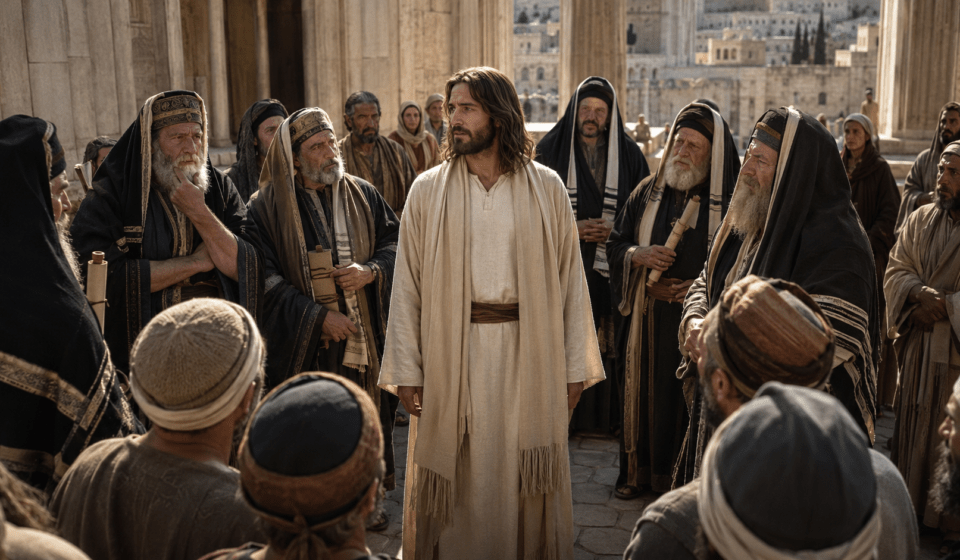
They came to interrogate Jesus.
By the end of the day, they were the ones exposed.
Tuesday is the day the Son on trial becomes the Judge.
They Questioned His Authority.
The leaders came first.
Religious authorities.
Experts in the Law.
Guardians of public righteousness.
They asked:
“By what authority are You doing these things?”
It sounded reasonable.
Who authorized You?
Who gave You the right to cleanse the temple?
Who do You think You are?
But Jesus did not submit to dishonest interrogation.
He answered with a question.
Was John’s baptism from heaven, or from man?
Now they were trapped.
If they said, “From heaven,” they would have to explain why they refused John.
If they said, “From man,” they feared the crowd.
So they answered:
“We do not know.”
That answer revealed everything.
They were not seeking truth.
They were protecting themselves.
The Questioners Were Exposed.
Jesus was not avoiding the question.
He was exposing the questioners.
Their problem was not lack of evidence.
It was lack of surrender.
God had already spoken through John.
They refused him.
God was now speaking through His Son.
They were preparing to kill Him.
Their questions sounded theological.
But underneath was fear.
Fear of losing power.
Fear of losing control.
Fear of losing status.
Fear of losing the right to rule their own lives.
That fear is not ancient.
It still lives in the human heart.
The Son in the Vineyard.
Then Jesus told a story.
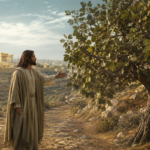
A man planted a vineyard.
He leased it to tenants.
When harvest came, he sent servants to collect fruit.
The tenants beat one.
Killed another.
Stoned another.
Again and again, the owner sent servants.
Again and again, they were rejected.
Finally, he sent his son.
“They will respect my son,” he said.
But the tenants saw the son and said:
“This is the heir. Come, let us kill him and have his inheritance.”
So they killed him.
Jesus asked what the owner would do.
The answer was unavoidable.
He would judge the wicked tenants.
He would give the vineyard to others.
The leaders knew.
He was speaking about them.
The Rejected Stone.
Then Jesus brought Scripture down like a blade:
“The stone that the builders rejected has become the cornerstone.”
They were the builders.
They were rejecting the Stone.
They were the tenants.
They were plotting against the Son.
But their rejection would not stop God’s plan.
The Son they rejected would become the Cornerstone.
The One they tried to remove would become the foundation.
The One they condemned would become the measure by which all are judged.
That is the terror and glory of Tuesday.
Jesus can be rejected by men and still be chosen by God.
He can be put on trial and still be the Judge.
The Question This Forces.
Tuesday is not only about ancient leaders.
It is about every heart that tries to put Jesus on trial.
The skeptic can do this.
Questions are good.
Honest questions matter.
But some questions are not seeking truth.
They are shields against surrender.
The seeker can do this too.
Circling Jesus.
Studying Jesus.
Admiring Jesus.
But never yielding to Jesus.
The believer can do it quietly.
Calling Him Lord while protecting one forbidden room.
Money.
Sexuality.
Forgiveness.
Ambition.
Pride.
Anger.
Comfort.
Secret sin.
Tuesday asks:
Are you questioning Jesus to find Him, or to avoid Him?
You Cannot Keep Him Under Examination.
Jesus is patient with honest seekers.
He is tender with the confused.
He is merciful to sinners who come into the light.
But He will not flatter proud unbelief.
He will not pretend evasion is wisdom.
He will not let us hide behind questions forever.
You may ask Him questions.
But eventually His questions find you.
What have you done with the Son?
What have you built your life on?
What truth has God already shown you that you still refuse to obey?
The Verdict.
Tuesday destroys the illusion that Jesus is the one on trial.
He is the Son.
He is the Heir.
He is the Cornerstone.
He is the Son of Man who will come in glory.
He is not waiting for human permission to be Lord.
He already has authority.
The only question is whether you will acknowledge it now.
You cannot admire Jesus while evading His authority.
You cannot praise His wisdom while rejecting His claim.
You cannot call Him Lord and reserve the right to overrule Him.
The rejected Stone will either become the foundation beneath your feet—
or the Stone over which you fall.
The verdict of Tuesday is clear.
Stop putting Jesus on trial.
Stand before Him honestly.
Receive the Son.
Build on the Cornerstone.
And stay awake.
Key Verse.
“The stone that the builders rejected has become the cornerstone.”
— Matthew 21:42
One Sentence to Remember.
You cannot admire Jesus while evading His authority.
Discussion Question.
Where are you tempted to question Jesus in order to avoid obeying Him?
A Prayer for the Day.
Lord Jesus, I confess that I have sometimes questioned You to avoid surrendering to You. I have hidden behind delay, doubt, and control when You were calling me to trust and obey. Forgive me. Give me an honest heart. Teach me to seek truth, not excuses. I receive You as the Son, the Heir, and the Cornerstone. Rule over me today. Amen.

Roger Wamba Sador
Roger is a student of Christocentric Apologetics, a passionate Servant of God whose work for JesusAccordingToJesus.com focuses on Passion Week, prophetic fulfillment, and the climactic self-revelation of Jesus in His death and resurrection. His writing examines the final days of Jesus’ earthly ministry with careful attention to the Gospel narratives: the triumphal entry, the cleansing of the temple, the confrontations in Jerusalem, the Last Supper, Gethsemane, the trials, the cross, the burial, the empty tomb, and the resurrection appearances. He is especially interested in how these events reveal not only what happened to Jesus, but who Jesus understood Himself to be and what He came to accomplish. Roger brings an analytical and historically attentive approach to the biblical text, tracing the connection between Jesus’ words, His deliberate movement toward Jerusalem, and the prophetic pattern fulfilled in His suffering, death, and vindication. His work presses readers to see that Passion Week was not a tragic accident or a religious symbol added later, but the purposeful fulfillment of Jesus’ mission. Rather than treating prophecy as vague prediction or detached proof-texting, Roger explores how the Scriptures converge in the person and work of Christ. His writing helps readers see the cross and resurrection as the decisive center of the Gospel: the place where Jesus’ identity, mission, authority, obedience, sacrifice, and victory come fully into view. Roger writes for seekers, skeptics, believers, and serious students of Scripture who want to understand why the final week of Jesus’ life stands at the heart of the Christian proclamation: He died, He was buried, He rose again, and He is alive.