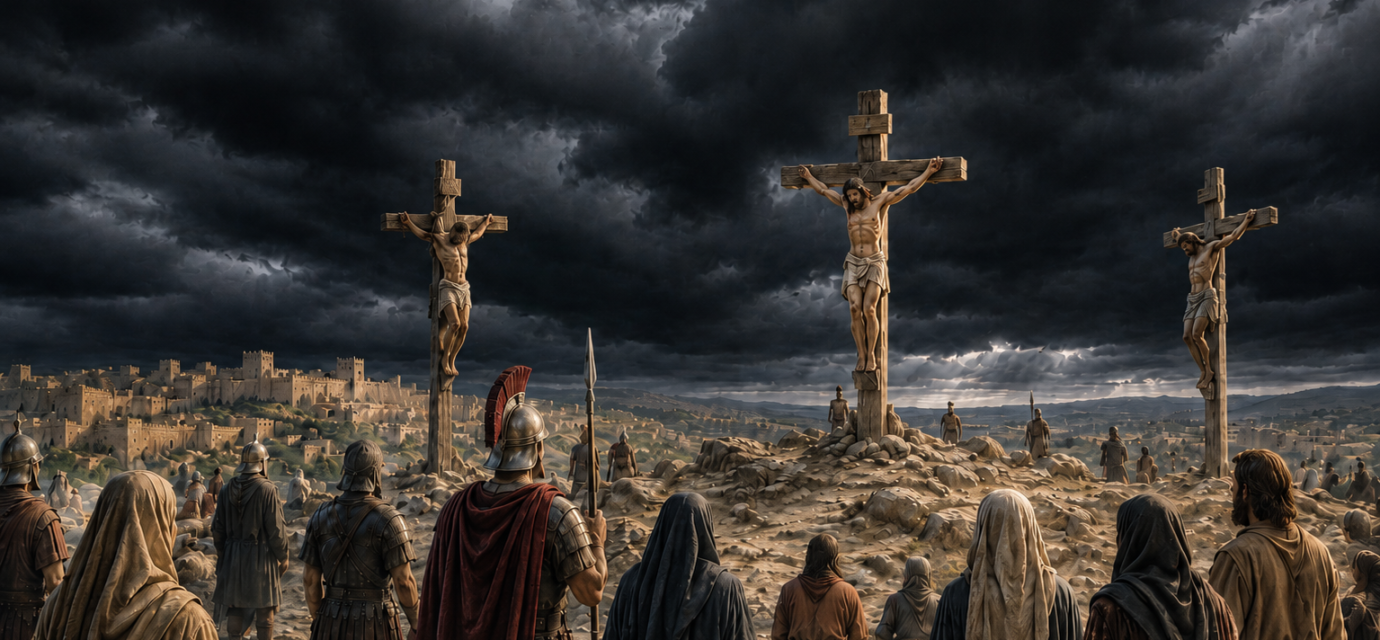
Behold the Man. Behold Your King. Behold Your Substitute.
Behold the Man. Behold Your King. Behold Your Substitute.
Good Friday and the Day Justice and Mercy Met
Primary Texts: Matthew 26:57–27:61; Mark 14:53–15:47; Luke 22:54–23:56; John 18:12–19:42; Isaiah 52:13–53:12; Psalm 22; Psalm 69
Main Sayings: “I am.” “Father, forgive them, for they know not what they do.” “Today you will be with Me in paradise.” “My God, My God, why have You forsaken Me?” “It is finished.” “Father, into Your hands I commit My spirit.”
The courtroom was a circus.
The charges were twisted.
The witnesses were confused.
The verdict was already waiting.
And the innocent One stood there in silence.
Good Friday is not tragedy alone.
It is judgment falling where mercy intends to save.
It is the day human courts condemned the innocent One.
And God revealed the only place where justice and forgiveness can meet.
The Innocent One Was Condemned
Jesus was taken first through the machinery of religious power.
Annas questioned Him.
Caiaphas condemned Him.
The council searched for testimony.
But the witnesses could not agree.
Then the high priest demanded:
“Are You the Christ, the Son of the Blessed?”
Jesus answered:
“I am.”
And He said they would see the Son of Man seated at the right hand of Power and coming with the clouds of heaven.
That was enough.
They tore their robes.
They called it blasphemy.
They declared Him worthy of death.
The Son of Man told the truth.
And they condemned Him for it.
Pilate Knew
Then they brought Jesus to Pilate.
Pilate questioned Him.
Pilate found no guilt deserving death.
But innocence was not enough to stop cowardice.
The leaders pressed harder.
The crowd demanded crucifixion.
Pilate tried to escape responsibility.
He sent Jesus to Herod.
Herod wanted entertainment.
A miracle.
A spectacle.
A performance.
Jesus gave him silence.
So Herod mocked Him and sent Him back.
Again Pilate knew.
Again the pressure grew.
Again justice bent beneath fear.
Finally, Pilate handed Him over to be crucified.
The Cross Exposed Us
While men judged Jesus, Jesus exposed them all.
The religious leaders exposed their envy.
Herod exposed his emptiness.
Pilate exposed his cowardice.
The crowd exposed its instability.
The soldiers exposed human cruelty.
The cross did not only reveal Jesus.
It revealed us.
Our religion can envy holiness.
Our power can fear truth.
Our curiosity can mock what it does not worship.
Our crowds can praise one day and condemn the next.
Our hands can wound the very One who came to save.
They Nailed Him to the Wood
They stripped Him.
They mocked Him.
They pressed thorns into His head.
They led Him to Golgotha.
They nailed Him to the wood.
And Jesus prayed:
“Father, forgive them, for they know not what they do.”
The rulers sneered.
The soldiers gambled.
The passersby shook their heads.
One criminal joined the mockery.
But the other turned.
He had no record to offer.
No time to repair his life.
No righteousness to present.
Only guilt.
Only need.
Only faith.
“Jesus, remember me when You come into Your kingdom.”
Jesus answered:
“Today you will be with Me in paradise.”
Even from the cross, the King was saving.
Darkness Fell
Then darkness fell.
The earth shook.
The temple curtain tore in two.
Jesus cried:
“My God, My God, why have You forsaken Me?”
Then:
“It is finished.”
And finally:
“Father, into Your hands I commit My spirit.”
Then He bowed His head.
And gave up His spirit.
Not because death conquered Him.
Because He gave Himself.
Justice and Mercy Met
So what happened on the cross?
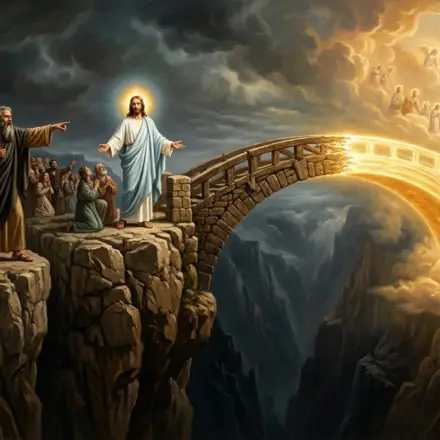
The Judge of all the earth stood in the place of the judged.
God did not ignore sin.
He dealt with it.
God did not cancel justice.
He satisfied it.
God did not forgive by pretending evil was small.
He forgave by bearing its cost.
The cross is not the Father punishing an unwilling victim.
The Son gave Himself freely.
The Father and the Son acted in perfect unity.
To do what only God could do.
Open a way for sinners to be forgiven without holiness being denied.
Jesus was innocent.
Yet treated as guilty.
Sinless.
Yet numbered with transgressors.
Rejected by men.
Yet accomplishing the mercy of God.
The Cross Destroys Neutrality
You cannot merely admire the cross from a distance.
You cannot reduce it to tragedy.
Or art.
Or injustice.
Or inspiration.
The cross says sin is more serious than we imagined.
The cross says love is deeper than we hoped.
The cross says justice matters.
The cross says mercy has come.
So what will you do with the Man on the cross?
Behold Him.
Not as a victim only.
Not as a teacher only.
Not as a symbol only.
Behold the Man who bore the weight of sin.
Behold the King who reigns from a cross.
Behold the Substitute who opens the way to God.
The Verdict
Good Friday is not Easter yet.
The tomb still waits.
The silence is still coming.
But the work of redemption has been accomplished.
The hands men nailed down were the hands holding mercy open.
The blood men spilled was the blood sealing the new covenant.
The death men intended as defeat became the altar where grace met judgment and triumphed.
So do not look away.
Do not stand neutral.
Do not call Him tragic and refuse to call Him Lord.
Behold the Man.
Behold your King.
Behold your Substitute.
And respond.
Key Verse
“Behold your King!”
— John 19:14
One Sentence to Remember
The cross destroys neutrality: behold the Man, behold your King, behold your Substitute.
Discussion Question
How does the cross change the way you understand both God’s justice and His mercy?
A Prayer for the Day
Lord Jesus, I look at the cross and see both my sin and Your love. You were innocent, yet You stood in the place of sinners. You were rejected, yet You opened the way to God. Forgive me for standing at a distance. I receive Your mercy. I bow before You as King. Thank You for giving Yourself for me. Amen.

Roger Wamba Sador
Roger is a student of Christocentric Apologetics, a passionate Servant of God whose work for JesusAccordingToJesus.com focuses on Passion Week, prophetic fulfillment, and the climactic self-revelation of Jesus in His death and resurrection. His writing examines the final days of Jesus’ earthly ministry with careful attention to the Gospel narratives: the triumphal entry, the cleansing of the temple, the confrontations in Jerusalem, the Last Supper, Gethsemane, the trials, the cross, the burial, the empty tomb, and the resurrection appearances. He is especially interested in how these events reveal not only what happened to Jesus, but who Jesus understood Himself to be and what He came to accomplish. Roger brings an analytical and historically attentive approach to the biblical text, tracing the connection between Jesus’ words, His deliberate movement toward Jerusalem, and the prophetic pattern fulfilled in His suffering, death, and vindication. His work presses readers to see that Passion Week was not a tragic accident or a religious symbol added later, but the purposeful fulfillment of Jesus’ mission. Rather than treating prophecy as vague prediction or detached proof-texting, Roger explores how the Scriptures converge in the person and work of Christ. His writing helps readers see the cross and resurrection as the decisive center of the Gospel: the place where Jesus’ identity, mission, authority, obedience, sacrifice, and victory come fully into view. Roger writes for seekers, skeptics, believers, and serious students of Scripture who want to understand why the final week of Jesus’ life stands at the heart of the Christian proclamation: He died, He was buried, He rose again, and He is alive.