This Is My Blood of the Covenant

Primary Texts: Matthew 26:17–35; Mark 14:12–31; Luke 22:7–38; John 13–17
Main Sayings: “This is my body.” “This is my blood of the covenant, which is poured out for many for the forgiveness of sins.” “I am the way, and the truth, and the life.” “Do this in remembrance of me.”
Jesus has spoken about judgment, watchfulness, and the coming of the Son of Man.
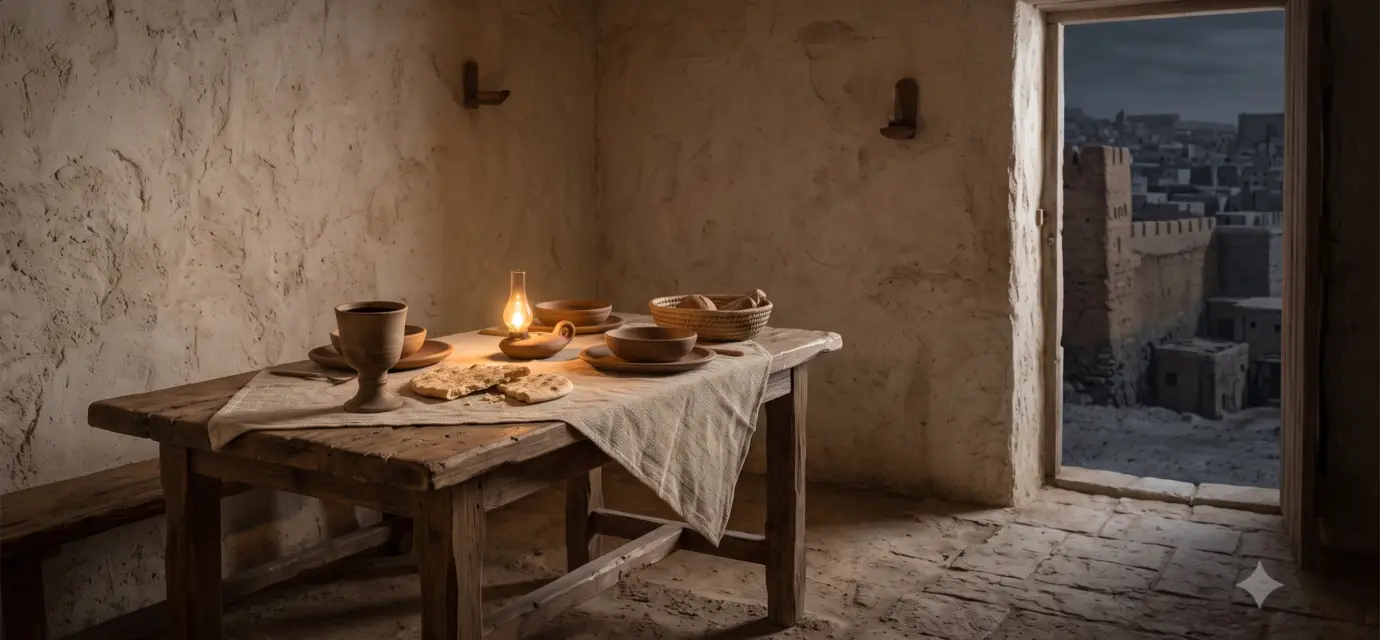
Now He sits at a table.
It is Passover. The night is heavy. Betrayal is near. Arrest is coming. The cross is no longer distant.
But Jesus is not confused.
He does not stumble into death as a victim of events. He interprets His death before it happens.
That is what makes the Last Supper unavoidable.
Jesus Knows the Betrayal
At the table, Jesus says one of them will betray Him.
The room becomes troubled. The disciples ask, “Is it I?”
Jesus knows.
He is not naïve about human loyalty. He is not fooled by closeness, religious language, or outward association.
A man can sit at the table and still betray the Lord.
That warning reaches every generation.
Being near holy things is not the same as belonging to Christ.
Religious access is not the same as surrendered faith.
External association is not rescue.
Jesus sees through the room.
“This Is My Body”
Then Jesus takes bread, gives thanks, breaks it, and says:
“This is my body.”
He takes the ordinary meal and places Himself at its center.
He does not merely say, “Remember God’s past deliverance.”
He says, in effect, remember Me.
This is a staggering move.
At Passover, Israel remembered deliverance from slavery. Blood marked the houses. Judgment passed over. God rescued His people.
Now Jesus takes the meal and points to His own body.
The old deliverance was real.
But Jesus is showing that a deeper deliverance is arriving through Him.
Blood for Forgiveness
Then He takes the cup and says:
“This is my blood of the covenant, which is poured out for many for the forgiveness of sins.”
This is one of the clearest statements Jesus ever gives about His death.
His death is not merely tragedy.
Not merely martyrdom.
Not merely an example of courage.
Not merely proof that the innocent suffer.
Jesus says His blood is covenant blood.
It is poured out for many.
It is for the forgiveness of sins.
That confronts every view that treats forgiveness as automatic, cheap, earned, inherited, or achieved by moral balancing.
Jesus does not say, “Your sincerity will erase your sins.”
He does not say, “Your rituals will remove your guilt.”
He does not say, “Your good deeds will outweigh your evil.”
He points to His blood.
If Jesus is right, forgiveness is not grounded in human effort. It is grounded in His self-giving death.
The Servant at the Table
John tells us that Jesus rises from supper, lays aside His outer garments, takes a towel, and washes His disciples’ feet.
The Lord stoops.
The Master serves.
Peter resists, but Jesus says:
“If I do not wash you, you have no share with me.”
That sentence cuts deeply.
Human pride wants to contribute, perform, deserve, and control. Jesus says we must be washed by Him.
Not merely taught by Him.
Not merely inspired by Him.
Washed by Him.
There is a cleansing only Jesus gives, and without it we have no share with Him.
The Way to the Father
As the night continues, Jesus comforts His disciples with words that are both tender and exclusive:
“I am the way, and the truth, and the life. No one comes to the Father except through me.”
This is not narrowness for the sake of narrowness.
It is clarity from the One who is about to give His body and blood.
If access to the Father could be found through any path of human construction, the cross would not stand at the center.
But Jesus places Himself there.
He is not one guide among many.
He is the way.
Why This Matters
Movement 10 shows Jesus interpreting His death.
He knows the betrayal.
He gives the bread as His body.
He gives the cup as His blood.
He says His blood is poured out for forgiveness.
He washes His disciples and says they must be washed by Him.
He declares Himself the way to the Father.
This leaves no room for a crossless Jesus.
No room for forgiveness without His blood.
No room for self-cleansing pride.
No room for treating Him as optional.
At the table, before the nails, Jesus tells us what His death means.
The question is whether we will believe His explanation.
If you are ready to understand why Jesus stands at the center of truth, meaning, forgiveness, and life, continue here: https://logosmap.org/en/meet-the-logos.

Waroal Peterson
Waroal Peterson is a staff writer for JesusAccordingToJesus.com, where he writes as a Christocentric apologist with a focused interest in the Gospel narratives and the progressive revelation of Jesus’ identity and mission. His work traces how Jesus reveals Himself through His own words, actions, conflicts, claims, compassion, suffering, death, and resurrection. Rather than beginning with religious labels or inherited assumptions, Waroal presses readers back into the text of the Gospels, asking what Jesus Himself says, shows, demands, promises, and fulfills. He is especially concerned with the unfolding logic of Jesus’ mission: the Son sent by the Father, the arrival of the kingdom, the call to repentance and faith, the authority to forgive sins, the necessity of the cross, and the vindication of the resurrection. His writing seeks to help readers see that the Gospel is not merely an idea to admire, but the announcement of who Jesus is and what He came to accomplish. Waroal writes for seekers, skeptics, new believers, and serious students of Scripture who want to encounter Jesus according to Jesus.







[…] ← Previous: Movement 10Next: Movement 12 → […]
[…] Movement 10 of 12 · Coming in this journey This Is My Blood of the Covenant Matthew 26:17–35; Ma… […]
[…] Movement 10 of 12 · Coming in this journey This Is My Blood of the Covenant Matthew 26:17–35; Ma… […]
[…] Movement 10 of 12 · Coming in this journey This Is My Blood of the Covenant Matthew 26:17–35; Ma… […]