

The First Recorded Words of Jesus: “My Father’s House”

Primary Text: Luke 2:41–52
Main Saying: “Did you not know that I must be in my Father’s house?” — Luke 2:49
Before Jesus ever preaches a sermon, heals the sick, casts out demons, forgives sins, or predicts His death and resurrection, Luke gives us one scene from His childhood.
It is easy to skip over it.
But if we are asking, “Who is Jesus according to Jesus?” then this scene matters. These are the first recorded words of Jesus in the Gospels.
And they are not casual words.
Jesus in the Temple at Age Twelve
Luke tells us that Jesus’ family went to Jerusalem every year for the Feast of Passover. When Jesus was twelve years old, they went up as usual.
After the feast ended, Mary and Joseph began the journey home. They assumed Jesus was somewhere in the traveling group, likely among relatives and acquaintances.
But He was not.
After a day of travel, they began searching for Him. When they could not find Him, they returned to Jerusalem.
For three days, they searched.
That detail matters. This was not a brief misunderstanding. Mary and Joseph were distressed. Any parent can understand the panic.
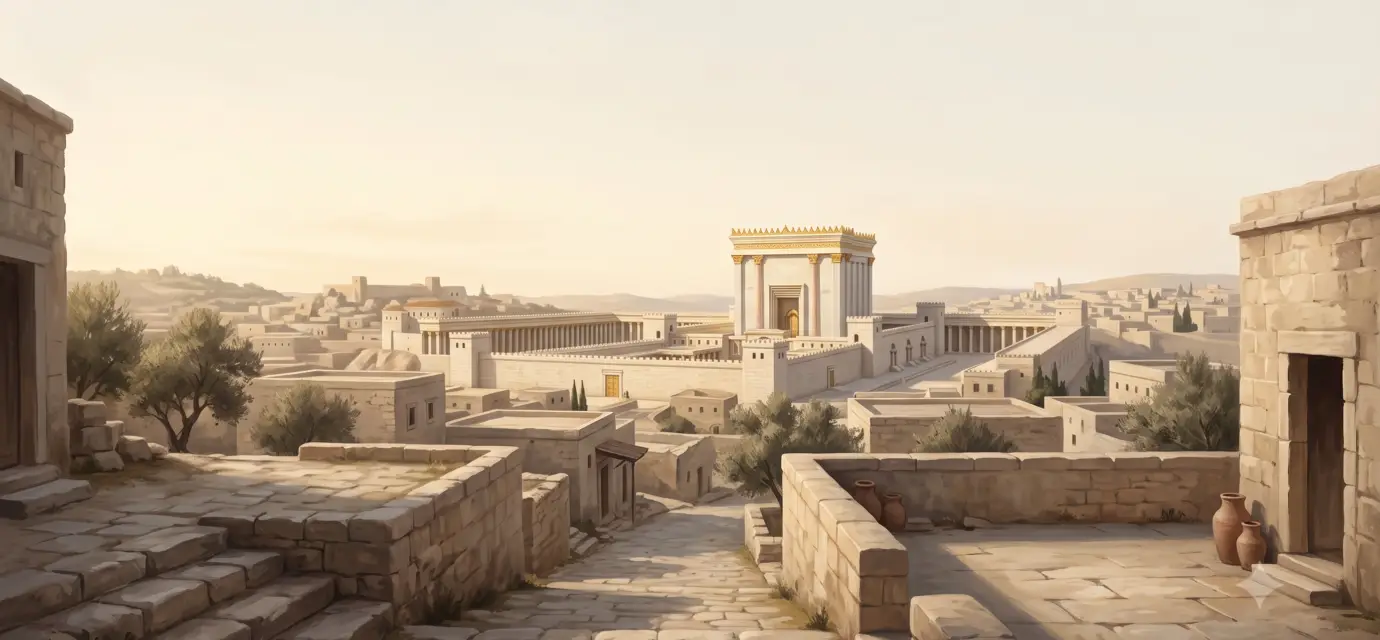
Finally, they found Him in the temple.
Jesus was sitting among the teachers, listening to them and asking questions. Luke says everyone who heard Him was amazed at His understanding and His answers.
Notice the balance. Jesus is not pictured as a noisy child showing off. He is listening. He is asking. He is answering. He is engaging the teachers of Israel in the place where Scripture, worship, sacrifice, and national hope all came together.
This is Jesus in the temple at age 12.
And then Mary speaks.
“Son, why have you treated us so? Behold, your father and I have been searching for you in great distress.”
Her words are understandable. She speaks as a mother. She names the pain of the search.
Jesus answers:
“Why were you looking for me? Did you not know that I must be in my Father’s house?”
“Did You Not Know?”
This is where the scene becomes more than a childhood memory.
Jesus does not say, “I got distracted.”
He does not say, “I lost track of time.”
He does not say, “I wanted to talk to the teachers.”
He says, “Did you not know?”
That answer assumes that His presence in the temple should make sense once His identity is understood.
To a skeptical reader, this is worth slowing down.
Luke is not presenting Jesus as a child who merely enjoys religion. He is presenting Jesus as a child who already understands Himself in relation to God in a unique way.
Mary says, “your father and I.”
Jesus says, “my Father.”
That contrast is gentle, but serious.
Jesus returns to Nazareth with Mary and Joseph and submits to them. So this is not teenage disrespect. Luke explicitly removes that misunderstanding.
But Jesus is making something clear: His deepest identity is not finally explained by His earthly household.
He belongs to the Father.
“I Must Be in My Father’s House”
The word “must” is important.
Jesus does not describe His presence in the temple as a preference. He describes it as necessity.
“I must be in my Father’s house.”
This is one of the earliest signs that Jesus understands His life as directed by divine purpose.
Later in the Gospels, Jesus will use this same kind of necessity language again.
He must preach the kingdom.
He must go to Jerusalem.
He must suffer.
He must be rejected.
He must be killed.
He must rise.
But here, the first “must” is connected to the Father.
That means the story of Jesus does not begin with public popularity, miracles, or confrontation. It begins with sonship.
Before Jesus stands before crowds, He stands in relation to the Father.
Before Jesus announces the kingdom, He knows the Father’s house.
Before Jesus is publicly declared the beloved Son at His baptism, He already speaks as the Son who knows where He belongs.
What This Reveals About Jesus
This passage does not tell us everything about Jesus.
It does not yet explain the cross. It does not yet reveal the resurrection. It does not yet show Him forgiving sins, commanding storms, or raising the dead.
But it does place the first stone in the road.
Jesus’ first recorded words reveal a child who is already conscious of God as His Father in a way that distinguishes Him even from His earthly family.
That is historically and theologically significant inside Luke’s Gospel.
Mary and Joseph do not fully understand Him. Luke says, “They did not understand the saying that he spoke to them.”
That detail is honest.
Even those closest to Jesus had to wrestle with who He was. They did not begin with a fully developed explanation of everything. They had to watch, remember, and slowly understand.
Luke says Mary treasured these things in her heart.
That is a good posture for the reader too.
Do not rush past the scene. Do not force a label too quickly. But do not soften the words either.
Jesus says He must be in His Father’s house.
Why These First Words Matter
For a religious skeptic, this scene raises a question:
Was Jesus merely another teacher who later became exaggerated by His followers?
For a non-religious skeptic, the question may be even simpler:
When did Jesus begin to understand Himself as someone uniquely related to God?
Luke’s answer begins here.
At twelve years old, Jesus is not yet making public claims before the nation. But He is already speaking with a sense of divine sonship and mission.
So the first recorded words of Jesus are not a moral slogan. They are not advice. They are not a general statement about kindness or spirituality.
They are identity words.
“My Father’s house.”
The child in the temple will later become the man who says He was sent by the Father, speaks the Father’s words, does the Father’s will, and fulfills the Father’s mission.
The first words already point toward the central question:
Who is this Son who knows He belongs uniquely to the Father?

Waroal Peterson
Waroal Peterson is a staff writer for JesusAccordingToJesus.com, where he writes as a Christocentric apologist with a focused interest in the Gospel narratives and the progressive revelation of Jesus’ identity and mission. His work traces how Jesus reveals Himself through His own words, actions, conflicts, claims, compassion, suffering, death, and resurrection. Rather than beginning with religious labels or inherited assumptions, Waroal presses readers back into the text of the Gospels, asking what Jesus Himself says, shows, demands, promises, and fulfills. He is especially concerned with the unfolding logic of Jesus’ mission: the Son sent by the Father, the arrival of the kingdom, the call to repentance and faith, the authority to forgive sins, the necessity of the cross, and the vindication of the resurrection. His writing seeks to help readers see that the Gospel is not merely an idea to admire, but the announcement of who Jesus is and what He came to accomplish. Waroal writes for seekers, skeptics, new believers, and serious students of Scripture who want to encounter Jesus according to Jesus.












[…] ← Previous: Movement 1Next: Movement 3 → […]
[…] Movement 1 of 12 · Already covered The First Recorded Words of Jesus: “My Father’s House” Lu… […]
[…] Movement 1 of 12 · Already covered The First Recorded Words of Jesus: “My Father’s House” Lu… […]